
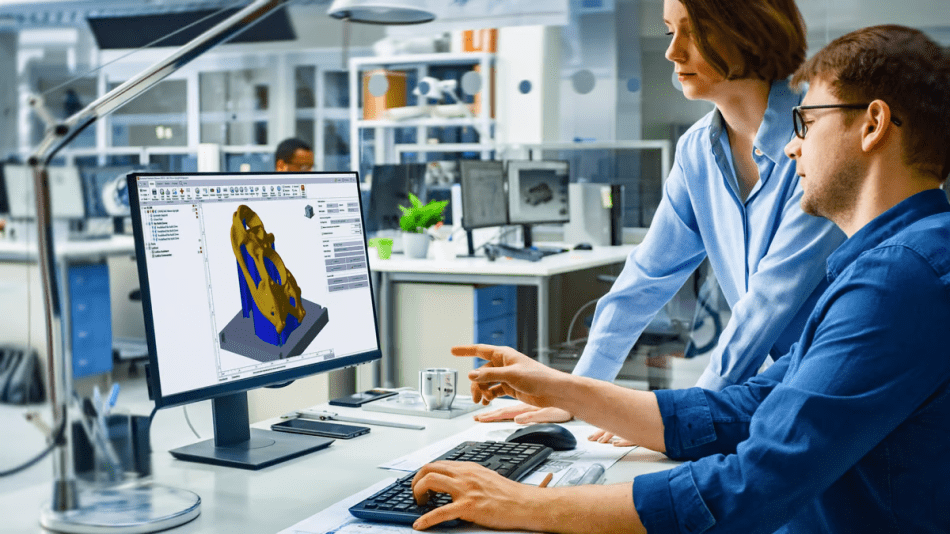
In additive manufacturing (AM), design is not an afterthought—it’s the enabler. Unlike subtractive or formative processes, where tooling and machining dictate constraints, AM introduces both design freedom and new challenges. Effective design for additive manufacturing (DfAM) means adapting geometry and part strategy to the capabilities and limitations of the chosen print technology.
This white paper provides practical engineering guidance for designing functional parts using industrial polymer AM technologies, particularly FDM, MJF, SLA, and SLS. The goal is not just to print parts—but to produce components that are efficient, repeatable, and ready for real-world performance.
Design Goals for Additive Manufacturing
DfAM focuses on aligning design intent with manufacturability. While AM enables features like internal channels, assembly consolidation, and lightweight structures, it also introduces unique issues: anisotropy, support requirements, and process-driven tolerances.
Effective additive design should:
- Reduce unnecessary mass while maintaining structural function
- Minimize supports and post-processing
- Leverage part orientation to align with mechanical load paths
- Simplify assembly through part consolidation
- Account for warping, shrinkage, and build material behavior
These considerations form the backbone of every design decision in additive workflows.
Wall Thickness and Feature Size
Wall thickness affects structural strength, print stability, and surface quality. Insufficient thickness can lead to warping or incomplete features; excessive thickness causes heat buildup and inefficient builds.
- FDM: 0.8 mm supported walls; 1.2 mm unsupported
- SLS/MJF: 0.75–1.0 mm minimum for small features
- SLA: 0.5 mm minimum for supported sections; ≥1.0 mm preferred for mechanical features
Uniformity is key—avoid sudden transitions that trap thermal stress. Thin pins, protrusions, and text should meet resolution thresholds for each technology. For instance, holes smaller than 2 mm may close in SLA due to light bleed; in FDM, small vertical holes tend to shrink due to nozzle rounding.
Overhangs, Bridges, and Support Minimization
Supports are necessary in processes like FDM and SLA, but they add time, material, and cleanup complexity. Well-designed parts minimize supports through smart geometry.
FDM tolerates overhangs up to 45°, and bridges of 5 mm are usually stable. SLA requires supports for all downward-facing surfaces. SLS and MJF use powder beds, eliminating traditional supports but still requiring clearance for powder removal in internal voids.
Chamfers, arches, or teardrop hole geometries can help reduce or eliminate supports.
Orientation, Strength, and Surface Quality
Orientation determines print time, surface finish, and mechanical properties. Most AM processes are anisotropic—parts are weakest along the Z-axis.
Designers should:
- Align critical load paths with the X-Y plane
- Use vertical orientation for improved surface resolution on curved features
- Minimize Z-height to reduce print time and risk of warping
Orientation also affects cosmetic quality. Steep angles on flat surfaces may show stepping; vertical features print more smoothly but may need supports.
Tolerance and Fit
Dimensional tolerances in AM vary by process and part geometry. In general, ±0.2–0.3 mm is achievable with well-tuned machines and suitable materials.
- For slip fits, plan for 0.2–0.4 mm clearance
- For press fits, reduce mating diameter by 0.1–0.2 mm
- For interference fits, validate via testing, especially in flexible or hygroscopic materials
Mating parts or assemblies should be prototyped early in design to avoid cumulative tolerance stack-ups.
Support Structures and Access
Support removal drives up labor cost and risk of damage. Parts with internal cavities should include access ports or design paths for tool-free removal. Powder-based processes require powder evacuation holes—typically ≥2 mm in diameter.
Designers should avoid “closed pockets” that trap support material, resin, or powder unless removal and cleaning have been considered.
Part Consolidation and Assembly Reduction
AM allows functional consolidation—designing single parts that replace multi-part assemblies. This reduces fasteners, joins, and cumulative tolerances.
Applications include:
- Brackets with integrated mounting features
- Ducts with printed-in channels or elbows
- Living hinges or flexures that replace mechanical joints
Even when full consolidation isn’t possible, engineers can simplify downstream assembly with keyed features, dovetails, and snap fits built into the print geometry.
Material Behavior and Functional Performance
Material choice determines success. Properties vary widely—not only between materials but based on print orientation, post-processing, and environmental exposure.
For example:
- Nylon (PA12) offers toughness and chemical resistance
- TPU provides flexibility, but is slower to print and less dimensionally stable
- PEI (ULTEM™ 9085) offers high-temperature performance and is flame retardant
AM data sheets provide a baseline—but actual part strength depends on orientation, infill, and post-processing.
Drainage, Powder Removal, and Internal Voids
Closed geometries can trap powder or resin, making cleaning difficult and increasing weight. Drainage channels, typically 2–3 mm in diameter, are essential for powder-based processes.
Designers should:
- Avoid long, narrow internal channels without access
- Use vent holes to avoid trapped gas or resin during curing
- Consider “cleanability” as part of the functional spec for enclosed features
Labeling, Engraving, and Surface Features
Surface text and logos should be designed with minimum depth and width suitable for the printer’s resolution.
- Embossed or engraved features should be at least 0.4 mm deep/high
- Lettering should use bold sans-serif fonts ≥2 mm tall
- Position markings on flat or convex surfaces for clarity
These features are best used for serial numbers, logos, and alignment marks—not cosmetic detail.
Post-Processing Considerations
Post-processing adds cost and complexity—so DfAM should aim to reduce it when possible. Still, finishing is often essential for precision fits, improved cosmetics, or durability.
Common steps include:
- Support removal (manual, chemical, or water-soluble)
- Surface smoothing (sanding, tumbling, vapor smoothing)
- Tapping, drilling, or reaming
- Coatings, sealing, or dyeing for UV, moisture, or wear resistance
Parts should be designed with post-processing in mind—avoid fragile features where cleanup is required.
Failure Mode Considerations
Poor DfAM leads to common failure modes: delamination, sagging, internal stress fractures, and dimensional drift. These issues often stem from bad orientation, unsupported geometry, or thermal imbalance.
Designers should validate:
- Z-loads on vertical features
- Overhangs or long bridges that may deform mid-print
- Uneven wall transitions that concentrate stress
Simulation and prototyping are the best defense—print early, test often.
Build Volume and Nesting Strategy
Maximizing build density reduces cost per part and improves throughput. For batch production, parts should be nested to minimize Z-height and take advantage of full build area.
Considerations include:
- Orientation tradeoffs between print quality and packing efficiency
- Risk of powder entrapment or support collision
- Separation spacing to avoid thermal fusion or collision artifacts
In MJF and SLS, dense nesting is standard. In FDM, avoid parts that risk warping each other through thermal bleed.
Material Selection Decision Matrix
Material selection depends on application, but the key variables to balance are:
| Property | Nylon (PA12) | TPU | ABS | PETG | PEI (ULTEM™) |
| Strength | High | Low-Med | Med | Med | High |
| Flexibility | Low | High | Low | Med | Low |
| Temp Resistance | Med | Low | Med | Med | High |
| Chemical Resistance | High | Med | Low | High | High |
| Print Complexity | Moderate | High | Easy | Easy | High |
Understanding these tradeoffs helps select the right material for both printability and end-use.
Cost Modeling in AM vs. Traditional Manufacturing
While AM excels at low-volume and custom production, it’s not always cheaper. Unit cost depends on:
- Material used (e.g., PEI is 10x more expensive than PLA)
- Print time (complexity, infill, layer height)
- Post-processing labor
- Yield (failure rate due to unsupported design)
In general:
- AM beats injection molding for volumes <1,000 units
- FDM is cheapest for large, simple parts
- SLA/SLS are better for cosmetic or mechanically loaded small parts
Cost per part decreases with smarter design—especially through orientation, nesting, and material selection.
Conclusion: Manufacturing with Intent
Designing for AM isn’t about stretching the limits of what’s possible—it’s about producing real parts that work techfelts. Strong DfAM means stronger, faster, and more consistent parts with less effort downstream. It’s about designing for the printer, not just with one.
Ready to design smarter for additive?
Let RapidMade help optimize your parts with expert DfAM consulting and industrial-grade 3D printing services.
???? Visit rapidmade.com or email info@rapidmade.com to start your project.
