
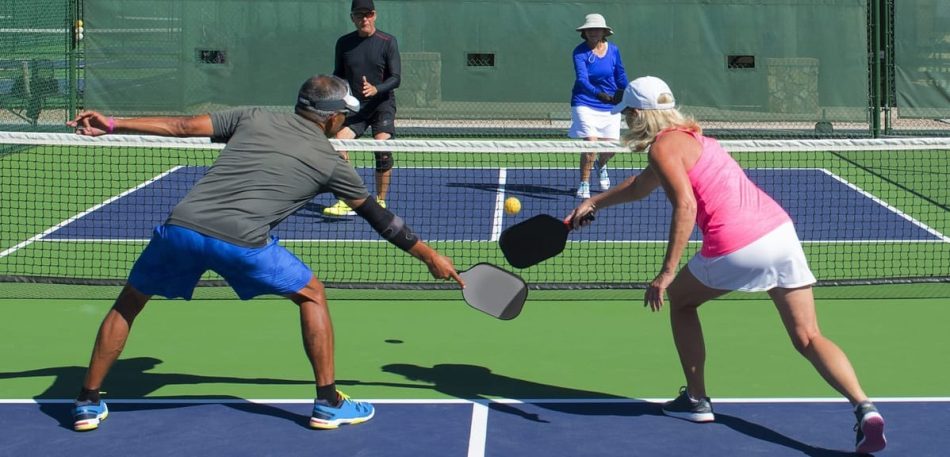
Pickleball has two distinct formats, singles and doubles, each requiring different strategies. Many players excel in one but struggle in the other, even though court dimensions remain the same. Singles rewards aggressive baseline play and exceptional fitness, while doubles emphasizes teamwork, positioning, and strategic patience.
Key Differences in Gameplay and Strategy
The most obvious difference between singles and doubles lies in court coverage. In singles, you’re responsible for the entire court width of 20 feet, while doubles players each cover roughly 10 feet of width. This fundamental change ripples through every aspect of strategy.
Court Positioning
Singles players typically position themselves closer to the center of the court, ready to move laterally to either side. The baseline becomes your home base, with occasional forward movement to attack short balls. Doubles players start with one person at the baseline and one at the net, working together to advance both players to the non-volley zone (kitchen) line.
Serving Strategy
In singles, the serving strategy focuses on placing opponents in difficult positions across the full width of the court. Deep serves to the corners create maximum movement requirements for your opponent. Doubles serving aims to keep the receiving team back, typically targeting the deep middle or the weaker player’s backhand.
Scoring Implications
Singles games use a two-number scoring system (your score, opponent’s score), while doubles adds a third number indicating which player is serving. This affects game flow and comeback potential. Singles matches often see more dramatic scoring swings because one player controls all points.
Singles Strategies: Court Coverage and Shot Selection
Singles pickleball demands exceptional fitness and court coverage skills. Success requires strategic shot placement combined with the endurance to maintain high-level play throughout longer rallies.
Movement and Positioning
Efficient movement patterns separate good singles players from great ones. After each shot, return to a central position about three feet behind the baseline. This gives you the best opportunity to reach shots hit to either corner. Practice the split-step timing—a small hop as your opponent contacts the ball—to improve reaction time.
Stay light on your feet and avoid getting caught flat-footed. The cross-court recovery step helps maintain balance while moving toward wide shots. When pulled out of position, focus on getting back to center court rather than attempting a risky winner.
Shot Selection Mastery
Depth control becomes critical in singles play. Aim for shots landing within three feet of the baseline to keep opponents pinned back. Short shots invite aggressive attacks and put you on defense immediately.
The cross-court dink strategy works differently in singles than doubles. Use cross-court shots to move opponents laterally, creating openings for down-the-line winners. However, be cautious with cross-court attempts from defensive positions, as they provide your opponent more angle options.
Drop shots become powerful weapons in singles when timed correctly. After establishing a pattern of deep shots, a well-placed drop shot can catch opponents off-guard and create easy putaway opportunities.
Serve and Return Strategy
Develop a consistent deep serve that lands within two feet of the baseline. Focus on placement over power—a serve that consistently reaches the back corners causes more problems than an occasional ace mixed with double faults.
On returns, prioritize depth and aim for the middle of the court. This neutral positioning prevents your opponent from immediately attacking with angled shots while you recover to center court.
Doubles Strategies: Communication and Teamwork
Doubles pickleball transforms individual shot-making into a team sport requiring constant communication and coordinated movement. The strongest doubles teams move as a unit, supporting each other’s positioning and shot selection.
Partner Communication
Establish clear communication patterns before points begin. Call “mine,” “yours,” or “switch” early and loudly enough for your partner to hear over ambient noise. Develop hand signals for serving strategies and positioning adjustments.
The “inside-out” rule helps determine shot responsibility. The player with the ball traveling toward their forehand side typically takes the shot, allowing for stronger returns and better court positioning afterward.
Positioning and Movement
The most successful doubles teams maintain parallel positioning—both players at the same depth on the court. When one player moves forward to attack a short ball, both players advance to the kitchen line together. When forced to retreat by a deep shot, both players move back as a unit.
Master the “shadow” technique where partners mirror each other’s lateral movement. If your partner moves left to cover a wide shot, you should also shift left to maintain proper court coverage and avoid creating a large gap down the middle.
The Third Shot Strategy
The third shot represents the most critical shot in doubles pickleball. After the serve and return (shots one and two), the serving team must execute a shot that allows them to advance to the net. The third shot drop—a soft, arcing shot that lands in the opponent’s kitchen—remains the gold standard.
Practice third shot drives as an alternative when opponents position themselves too far back. A well-placed drive forces quick reactions and can create errors or weak returns for easy putaways.
Advantages and Disadvantages of Each Format
Singles Advantages
Singles players develop superior fitness levels and court coverage skills that translate well to doubles play. You control every decision without needing to coordinate with a partner, allowing for aggressive shot-making and creative strategies.
The format rewards individual improvement directly—your practice time immediately benefits your match performance. Singles also provides excellent training for pressure situations since you handle all crucial points alone.
Singles Disadvantages
The physical demands can be overwhelming, especially for older players or those with mobility limitations. Longer rallies test endurance levels that some players cannot maintain consistently.
Recovery time between points becomes crucial, and players often struggle with the mental pressure of handling every situation independently. The margin for error shrinks since no partner can cover for mistakes.
Doubles Advantages
Doubles allows players of varying fitness levels to compete effectively by sharing court coverage responsibilities. The team aspect creates social connections and shared accountability that many players find motivating.
Strategic complexity increases with teamwork elements, making matches intellectually engaging beyond pure shot-making ability. Players can specialize in specific skills while relying on partners to complement their weaknesses.
Doubles Disadvantages
Communication breakdowns lead to frustrating errors and missed opportunities. Personality conflicts or differing play styles can create tension that affects performance. Players may become overly dependent on partners and struggle to develop complete individual skills.
Training Tips for Both Singles and Doubles
Singles-Specific Training
Cardiovascular fitness training should emphasize interval work that mimics match conditions. Sprint drills combined with recovery periods build the endurance needed for long rallies. Practice court coverage patterns through cone drills that simulate game movements.
Work on shot accuracy through target practice, aiming for specific court areas consistently. Set up targets in the deep corners and practice hitting them from various court positions. Mental toughness training helps handle the pressure of individual responsibility.
Doubles-Specific Training
Communication drills should be incorporated into every practice session. Practice calling shots while moving and under pressure. Work with multiple partners to develop adaptability and communication skills with different playing styles.
Positioning drills that emphasize moving as a unit help develop the instinctive coordination successful doubles teams display. Practice third shot drops and kitchen line exchanges extensively, as these situations determine most doubles points.
Cross-Training Benefits
Playing both formats improves overall pickleball skills significantly. Singles develops the fitness and court coverage that makes doubles positioning more effective. Doubles teaches strategic patience and teamwork that can inform smarter singles shot selection.
Many professional players, including those competing at the world pickleball championship level, excel in both formats by understanding how skills transfer between them. The mental aspects of each format complement each other—singles builds individual confidence while doubles develops strategic thinking.
Conclusion
Choosing between pickleball singles and doubles depends on your goals and preferences. Doubles are beginner-friendly and less physically demanding, while singles offer a tougher challenge requiring more fitness. Playing both enhances overall skills; doubles improves strategy, and singles boost fitness and shot accuracy. This balanced approach leads to a well-rounded game and continued enjoyment.
