
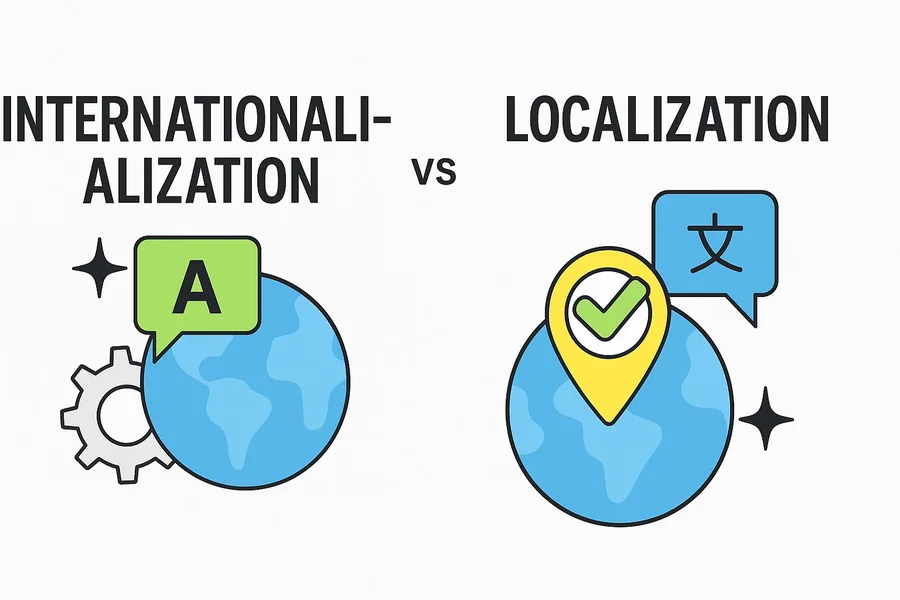
When expanding digital products across borders, understanding internationalization vs localization becomes crucial for success. While these terms are often used interchangeably, they represent distinct yet complementary processes in global product development. Internationalization lays the technical foundation that makes a product adaptable to any market, while localization tailors that product to resonate with specific cultural and linguistic audiences. Together, they form the backbone of effective global expansion strategies, enabling businesses to reach diverse markets while maintaining consistency and user engagement.
The distinction between these processes affects everything from development timelines and budget allocation to user experience and market penetration. Companies that master both approaches can launch products that feel native to users worldwide, creating competitive advantages in international markets. Whether you’re developing software, websites, mobile applications, or digital content, understanding how internationalization and localization work together determines your ability to scale globally while maintaining local relevance.
Internationalization (i18n): What it is
Internationalization, abbreviated as i18n (18 representing the number of letters between ‘i’ and ‘n’), is the process of designing and developing a product in a way that makes it easily adaptable to various languages, regions, and cultures without requiring engineering changes. This technical preparation happens during the development phase, creating a flexible architecture that can accommodate diverse global requirements.
The core principle of internationalization involves separating product content from code. Developers create a framework that can handle multiple languages, character sets, date formats, currency symbols, and cultural conventions without hardcoding these elements. This separation allows content to be modified or replaced without touching the underlying codebase, making future adaptations significantly more efficient and cost-effective.
Key technical aspects of internationalization include supporting Unicode character encoding to display text in any language, from Arabic and Chinese to Cyrillic and Devanagari scripts. The product architecture must accommodate bidirectional text for languages like Hebrew and Arabic that read right-to-left, while also supporting left-to-right languages. Additionally, internationalized products handle variable string lengths, as translated text can expand or contract significantly – German translations often require 30% more space than English, while some Asian languages may be more compact.
Internationalization also addresses formatting conventions that vary globally. Date formats differ substantially (MM/DD/YYYY in the US versus DD/MM/YYYY in Europe), as do time formats (12-hour versus 24-hour clocks), number separators (commas versus periods for decimals), and currency representations. An internationalized product automatically adapts these elements based on user locale settings rather than requiring separate versions for each market.
Another crucial aspect involves designing user interfaces with flexibility in mind. Buttons, menus, and layout elements must accommodate text expansion or contraction without breaking the design. Images, icons, and symbols should be culturally neutral or easily replaceable, avoiding content that might be offensive or confusing in certain cultures. Even color choices matter, as colors carry different meanings across cultures – white symbolizes purity in Western cultures but represents mourning in some Asian countries.
Localization (l10n): What it is
Localization, abbreviated as l10n (10 letters between ‘l’ and ‘n’), transforms an internationalized product to meet the specific linguistic, cultural, and functional requirements of a particular target market. While internationalization creates the possibility for adaptation, localization makes that adaptation real and relevant for end users in specific regions.
Translation forms the foundation of localization but represents only the beginning. Professional localization goes far beyond word-for-word translation to capture context, tone, idioms, and cultural nuances. A skilled localizer adapts humor, metaphors, and expressions that might not translate directly, ensuring content resonates authentically with the target audience. Marketing messages, slogans, and calls-to-action require creative adaptation rather than literal translation to maintain their persuasive impact.
Cultural adaptation encompasses numerous elements that affect user experience and perception. This includes modifying images and graphics to reflect local demographics, customs, and preferences. Product photos might show different models, clothing styles, or settings depending on the target market. Icons and symbols get reviewed for cultural appropriateness – a thumbs-up gesture, common in Western interfaces, is offensive in some Middle Eastern countries.
Localization also involves adapting content to local regulations, legal requirements, and industry standards. Privacy policies, terms of service, and disclaimers must comply with regional laws like GDPR in Europe or CCPA in California. Product specifications might need conversion to local measurement systems (metric versus imperial), and compliance certifications vary by country.
Payment methods, shipping options, and customer service channels require localization based on regional preferences. While credit cards dominate in the United States, many European customers prefer bank transfers, Asian markets favor digital wallets like WeChat Pay or Paytm, and Latin American users often rely on cash-on-delivery options. Contact information, business hours, and support channels should reflect local time zones and communication preferences.
Functional localization addresses features and capabilities that vary by market. This might include adding region-specific payment gateways, integrating with local social media platforms, or supporting local holiday calendars and observances. Some markets require specific features – for example, age verification systems vary by country, and some regions mandate specific accessibility features.
Quality assurance in localization extends beyond linguistic accuracy to include functional testing in target markets. This involves verifying that dates, times, currencies, and measurements display correctly, ensuring translated text fits properly within the interface, and confirming that local payment and shipping integrations work seamlessly.
The Relationship Between i18n and l10n
Internationalization and localization operate as sequential, interdependent processes that together enable global product success. Internationalization creates the technical foundation and flexibility, while localization builds upon that foundation to create market-specific versions. Neither process can succeed effectively without the other.
The relationship follows a logical sequence: internationalization must occur first during product development, establishing the architecture that makes localization possible. Attempting to localize a product that wasn’t internationalized results in expensive, time-consuming custom development for each market. Conversely, internationalizing a product without following through with localization leaves the potential for global reach unrealized.
Think of internationalization as building a house with modular rooms that can be decorated in countless ways, while localization is the actual decoration that makes each room feel like home to different occupants. The modular structure (internationalization) remains constant, but the finishing touches (localization) create unique experiences for different audiences.
This relationship creates significant efficiency gains. Once a product is properly internationalized, adding new markets through localization becomes relatively straightforward and cost-effective. The initial investment in internationalization pays dividends as companies expand to additional markets, because each new localization project leverages the same flexible foundation rather than requiring custom development.
The iterative nature of this relationship also supports continuous improvement. Feedback from localized versions often reveals internationalization gaps or opportunities for enhancement. These insights inform updates to the base product, making future localizations smoother and more effective.
Successful global products maintain this relationship through careful planning and coordination. Development teams must understand localization requirements to build appropriate internationalization features. Localization teams need visibility into the product architecture to work efficiently within its constraints. This collaboration ensures that technical capabilities align with market needs.
Why They Matter
The combined impact of internationalization and localization directly affects business growth, user satisfaction, and competitive positioning in global markets. Companies that excel at both processes access significantly larger addressable markets, while those that neglect them limit their growth potential.
From a business perspective, properly internationalized and localized products capture market share more effectively. Users strongly prefer products in their native language – 75% of consumers are more likely to purchase products with information in their own language, according to research by Common Sense Advisory. This preference intensifies in markets where English proficiency is lower. Additionally, localized products build trust and credibility, as they demonstrate respect for local culture and commitment to serving that market.
Revenue potential expands dramatically with effective internationalization and localization. The global e-commerce market exceeds $5 trillion annually, with significant portions in non-English speaking countries. China, Japan, Germany, the UK, and France represent massive opportunities that require localized experiences. Mobile app markets in India, Brazil, and Southeast Asia are growing rapidly, but success requires cultural and linguistic adaptation.
User experience improves substantially when products feel native rather than foreign. Localized interfaces reduce cognitive load, minimize confusion, and increase engagement. Users navigate more efficiently, complete tasks more successfully, and report higher satisfaction when interacting with products in their preferred language and cultural context. This improved experience translates to better retention, increased usage, and stronger word-of-mouth recommendations.
Competitive differentiation often hinges on localization quality. In markets where multiple companies offer similar products, superior localization becomes a decisive factor. Products that feel truly local – rather than obviously translated – create emotional connections with users and stand out from competitors who take shortcuts or neglect cultural nuances.
From an operational standpoint, proper internationalization reduces long-term costs despite requiring upfront investment. Building flexibility into the product architecture prevents expensive refactoring when expanding to new markets. Each subsequent localization becomes faster and cheaper, creating economies of scale that improve profitability over time.
Legal and regulatory compliance often depends on localization. Many countries require products to support local languages, currencies, and legal frameworks. The European Union mandates multilingual support for certain product categories. China requires specific certifications and content adaptations. Proper localization ensures compliance and avoids potential legal issues or market access restrictions.
Brand reputation benefits from culturally sensitive localization. Cultural mistakes – whether mistranslations, inappropriate imagery, or tone-deaf messaging – can damage brand perception and create public relations crises. Conversely, thoughtful localization that demonstrates cultural understanding builds positive brand associations and customer loyalty.
The technical advantages of internationalization extend to maintenance and updates. Changes to the base product automatically propagate to all localized versions once content is retranslated, rather than requiring separate updates to multiple codebases. This centralized approach reduces errors, ensures consistency, and accelerates release cycles.
FAQ
What’s the main difference between internationalization and localization?
Internationalization is the technical process of designing products to support multiple languages and regions, while localization is the cultural and linguistic adaptation of that product for specific markets. Internationalization happens once during development, localization happens repeatedly for each target market.
Which should come first, internationalization or localization?
Internationalization must come first. It creates the technical foundation that makes localization possible and cost-effective. Attempting to localize without proper internationalization results in expensive custom development for each market.
How much does internationalization cost compared to localization?
Internationalization typically requires a higher upfront investment (20-30% more development time initially) but reduces ongoing costs significantly. Localization costs vary by market but become much more affordable once internationalization is complete. The investment ratio often balances at 30% internationalization to 70% localization across multiple markets.
Can I skip internationalization and just translate my content?
Simple translation without internationalization creates maintenance nightmares, limits functionality, and often produces poor user experiences. Products may appear to work but will likely fail with date formats, currencies, text expansion, or cultural requirements. This approach becomes exponentially more expensive as you add markets.
How do I know if my product is properly internationalized?
Test your product with pseudo-localization (replacing text with expanded strings and special characters), verify support for right-to-left languages, check date/time/currency handling, and review whether content is separated from code. If changing languages requires code modifications, internationalization is incomplete.
What languages should I localize for first?
Start with markets offering the highest ROI based on your product category. Common priorities include Spanish, Chinese (Simplified), French, German, and Japanese, which together reach billions of potential users. Consider market size, purchasing power, competition, and strategic importance.
How often should localized content be updated?
Update localized content whenever the source content changes significantly, when entering new market segments, or when user feedback indicates issues. Regular review cycles (quarterly or biannually) help maintain quality and relevance as languages and cultures evolve.
Do I need native speakers for localization?
Yes, professional localization requires native speakers with cultural expertise and subject matter knowledge. Machine translation can supplement but cannot replace human localization, especially for marketing content, user interfaces, and culturally sensitive material. Quality localization combines linguistic skill with cultural understanding and industry expertise.
