
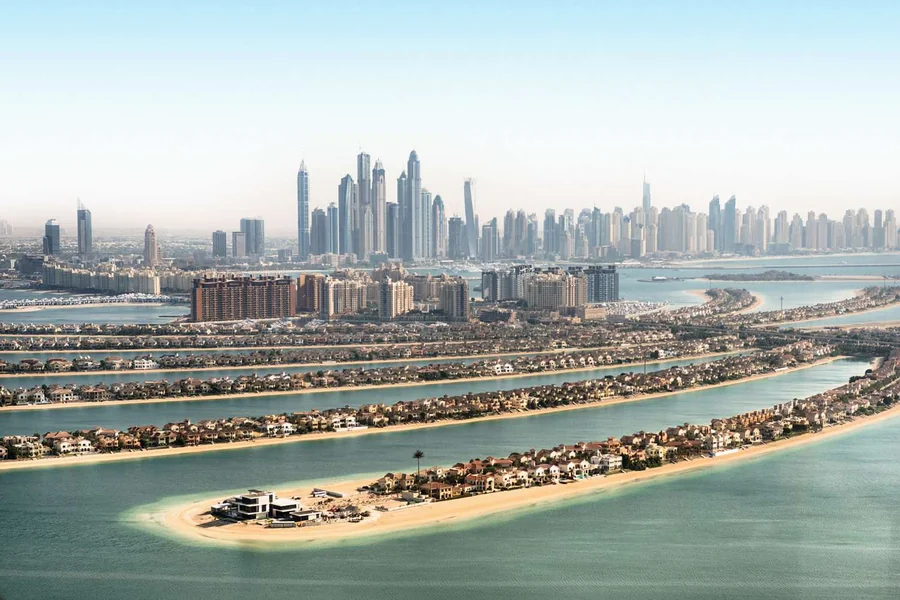
On the northern edge of the city, Dubai Islands offer a perspective on Dubai that feels markedly different from its global image of glass towers and high-speed urban life. Stretching along the coast, the district introduces a slower, more open relationship between the city and the sea. Instead of concentrating activity upward, the area unfolds horizontally, allowing light, water, and space to define the experience. For visitors and residents alike, this part of Dubai feels less like a destination built to impress and more like one designed to be lived in.
The character of the district is beginning to take shape through early residential and hospitality developments, including projects such as Villa del Garda, Ellington Cove, Azizi Wasel, Bay Villas by Nakheel, and other waterfront initiatives spread across the islands. Together, they signal the emergence of a neighborhood that balances urban convenience with coastal calm. Rather than dominating the landscape, these developments are arranged to work with it, shaping a setting where the sea remains present in everyday life.
A Coastline Designed for Everyday Discovery
What distinguishes this area is not a single landmark or attraction, but the way daily experiences are framed. Wide promenades, open sightlines, and access to the water encourage movement at a human pace. Morning walks along the shore, quiet afternoons near the beach, and evenings shaped by shifting light replace the intensity often associated with central Dubai. The environment invites exploration without urgency, offering space to notice details that are often lost in denser districts.
This approach reflects a broader shift in how cities think about their coastlines. Rather than reserving waterfronts solely for tourism or spectacle, Dubai Islands integrate them into everyday routines. Cafés, residential streets, and public spaces are positioned to maintain continuity with the sea, making the coastline a lived environment rather than a backdrop.
Seeing Dubai Beyond the Skyline
For many visitors, Dubai is defined by contrast: desert and city, tradition and futurism, stillness and speed. Dubai Islands add another layer to that contrast by introducing a quieter urban rhythm. The absence of extreme vertical density allows the horizon to remain visible, reinforcing a sense of orientation that is often missing in high-rise districts. Here, the sea functions as a constant reference point, grounding the experience of place.
This openness changes how the city is perceived. Distances feel shorter, transitions between spaces feel smoother, and time seems less compressed. The result is an environment that encourages lingering rather than rushing, observation rather than consumption. For those accustomed to exploring cities through iconic attractions, Dubai Islands suggest a different way of understanding place: through atmosphere and continuity.
Architecture That Steps Back
The architecture across the islands reflects this mindset. Buildings tend to emphasize proportion and materiality over visual dominance. Light-colored façades, recessed balconies, and large openings respond to the climate while maintaining a sense of softness. Interiors are often designed to extend outward, blurring the boundary between indoor and outdoor space.
This architectural restraint does not diminish the sense of luxury; instead, it reframes it. Comfort comes from space, privacy, and connection to the environment rather than from excess. It is a language increasingly familiar in coastal destinations around the world, adapted here to Dubai’s climate and cultural context.
A Place for Long Stays, Not Just Short Visits
Dubai Islands also appeal to a growing group of travelers and residents who prefer longer stays and deeper engagement with a place. The district’s layout supports routines rather than itineraries. Grocery stores, walking routes, and neighborhood cafés are as central to the experience as beaches and views. This makes the area particularly attractive to those who see travel not as escape, but as an extension of everyday life.
The proximity to older parts of the city adds another dimension. Traditional neighborhoods, local markets, and historical districts are within easy reach, creating a connection between Dubai’s past and its evolving coastal future. This relationship enriches the experience, offering cultural depth alongside modern comfort.
A Different Kind of Urban Escape
In a city known for reinvention, Dubai Islands represent a subtle but meaningful shift. They show how new districts can grow without overwhelming their surroundings, and how coastal development can prioritize livability alongside ambition. The islands do not compete with Dubai’s skyline; they complement it by offering an alternative way to experience the city.
As the district continues to develop, its appeal is likely to deepen. What begins as a place to explore may become a place to settle into, defined not by spectacle, but by the quiet confidence of a city learning to slow down at the water’s edge.
