
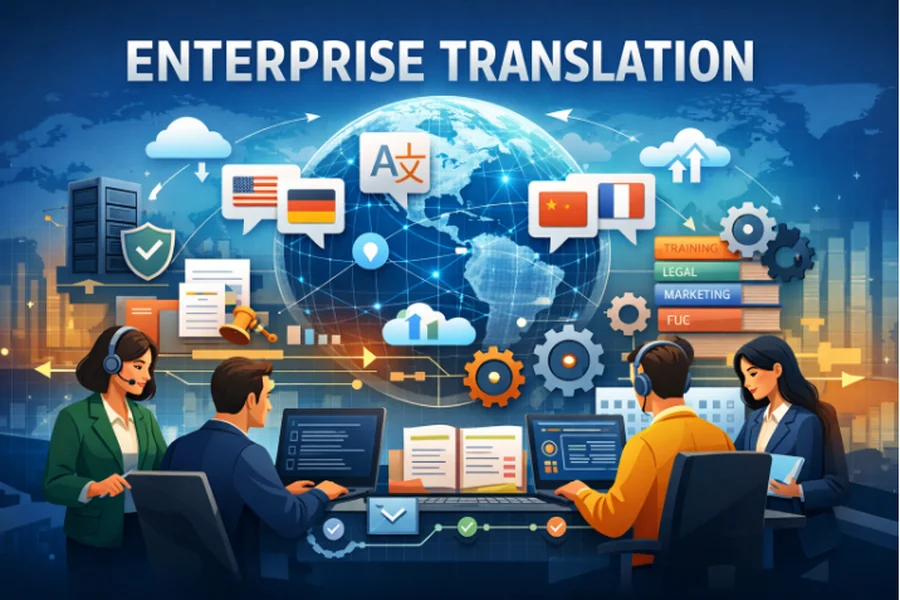
Large enterprises operate in a multilingual reality by default. Product interfaces, legal documentation, internal policies, marketing assets, onboarding materials, and support content are created continuously and consumed across regions. At this scale, translation can no longer be handled as a collection of isolated tasks. Organizations increasingly rely on specialized services to manage enterprise translation as a coordinated, repeatable system – one that supports speed, linguistic quality, regulatory compliance, and cross-team alignment at the same time.
As companies mature, translation shifts from a reactive function to a structured service layer embedded into the business. Instead of chasing files and deadlines, teams work within defined workflows, use centralized language assets, and integrate translation services directly into their technology stack. The result is more than operational efficiency: it is a dependable global content engine that enables consistent growth across markets without fragmentation or loss of control.
Enterprise Translation: What Makes It Different
Enterprise translation is defined by complexity rather than language count alone. Before selecting tools or vendors, organizations need to understand the forces that shape large-scale localization.
Key factors include:
- High content volume and velocity
Enterprises release updates constantly. Translation must support continuous delivery, not quarterly batch projects. - Multiple stakeholders
Product, legal, HR, marketing, support, and regional teams all create content, each with different priorities, formats, and risk levels. - Regulatory and brand exposure
Errors in contracts, safety documentation, or compliance notices carry legal and reputational risk, making review and governance critical. - Fragmented technology ecosystems
Content lives across CMS platforms, code repositories, help centers, design tools, and knowledge bases. Manual handling does not scale.
At this level, translation success depends on ownership and structure: who defines standards, who approves terminology, how vendors are managed, and how regional teams contribute without diluting brand consistency.
Designing a Strategy to Manage Enterprise Translation
A strong enterprise translation strategy connects business objectives with operational reality. It clarifies why translation matters and how it will be executed across the organization.
Effective strategies typically include:
Central Governance with Local Adaptation
A central localization function sets standards, tools, workflows, and KPIs. Regional teams retain flexibility to adapt content within clearly defined boundaries.
Content and Market Prioritization
Not all content requires the same level of investment. Enterprises define tiers – global-mandatory, priority markets only, or English-only – to allocate resources where they matter most.
Workflow Models by Content Type
Legal contracts, product UI, marketing campaigns, and training materials each demand different workflows. Defining templates by content type avoids reinvention and reduces errors.
Shared Language Assets
Translation memories, terminology databases, and style guides must be centralized, maintained, and enforced. This ensures consistency and prevents paying repeatedly for the same work.
Measurement and Optimization
KPIs such as turnaround time, reuse rate, cost efficiency, and quality scores provide visibility. Continuous review turns translation into a measurable business function rather than a cost center.
With this foundation, enterprises gain predictability and scale without sacrificing control.
Solutions That Support Enterprise-Scale Translation
Most enterprises rely on an ecosystem of tools and practices rather than a single solution. Common components include:
Translation Management Platforms
A cloud-based TMS centralizes projects, workflows, users, and language assets while integrating with development tools, CMSs, and design platforms. It acts as the operational backbone for large-scale translation.
Professional CAT Tools
Translator workbenches enable efficient, segment-based translation with built-in QA, terminology enforcement, and reuse of existing content.
Machine Translation with Governance
Neural MT accelerates delivery for low- and medium-risk content. Enterprises apply different MT policies depending on visibility and legal exposure, always within controlled workflows.
Terminology and Style Management
Central glossaries and style guides protect product naming, legal phrasing, and brand voice across languages and teams.
Automated and Linguistic QA
Automated checks catch formatting, placeholders, and numerical errors, while linguistic QA ensures readability, tone, and cultural appropriateness.
Vendor and Resource Management
Clear onboarding, SLAs, performance tracking, and feedback loops help maintain quality across large networks of vendors and reviewers.
Localization-Ready Content Practices
Writing and designing with localization in mind – clear language, flexible UI layouts, no hard-coded strings – reduces downstream cost and rework.
Together, these elements turn enterprise translation from a fragile process into a scalable system.
Real-World Enterprise Translation Scenarios
- A SaaS company integrates its translation platform with GitHub so every new UI string automatically enters a localization workflow and is merged back without manual file handling.
- A global e-commerce brand uses MT with human post-editing for SEO pages while reserving full human transcreation for flagship campaigns.
- A manufacturing enterprise applies strict two-step human review and automated QA for safety and compliance documentation to meet regulatory requirements.
These setups show how structured workflows replace ad-hoc translation decisions.
Policies That Enable Scale
Enterprises often formalize translation through internal playbooks, including:
- Content tiering policies defining quality levels by risk
- Market coverage policies identifying core, growth, and long-tail regions
- Terminology approval rules involving product, legal, and marketing teams
- Security and confidentiality requirements governing vendors and MT usage
Such policies transform translation from tribal knowledge into an executable operating model.
FAQs
What does it mean to manage enterprise translation effectively?
To manage enterprise translation effectively means having centralized governance, standardized workflows, and integrated technology that supports large volumes of multilingual content across teams and markets. It involves coordinating people, tools, vendors, and language assets so translation scales without losing quality, speed, or brand consistency.
Why do enterprises struggle with translation at scale?
Most challenges come from fragmentation. Different teams use different tools, vendors, and processes, leading to duplicated work, inconsistent terminology, higher costs, and slower releases. Without a unified system, translation becomes reactive rather than strategic.
How is enterprise translation different from standard localization?
Enterprise translation operates at a much higher level of complexity. It must support multiple stakeholders, continuous content updates, regulatory compliance, security requirements, and global brand governance. Standard localization workflows are often too manual or project-based to handle this scale.
Do enterprises need a centralized localization team?
In most cases, yes. A centralized localization or globalization team defines standards, manages tools and vendors, and ensures consistency across the organization. Local teams still contribute, but within a shared framework that prevents fragmentation.
How can enterprises balance speed and quality?
By applying different workflows based on content risk. Low-risk internal content can use machine translation with minimal review, while high-risk or high-visibility content requires full human translation and multi-step review. Automation handles speed; governance protects quality.
What role does automation play in enterprise translation?
Automation handles repetitive and technical tasks such as content extraction, task assignment, file synchronization, QA checks, and publishing. This reduces manual errors and frees linguists and managers to focus on quality, context, and strategic decisions.
How do translation memories and glossaries help at scale?
They prevent re-translation of similar content, reduce costs, speed up delivery, and ensure consistent terminology across all languages and teams. For enterprises, centrally managed language assets are critical to maintaining brand and legal consistency.
Can enterprise translation support continuous product releases?
Yes. When integrated with CI/CD pipelines and content systems, enterprise translation can run continuously alongside development. This allows global releases to happen simultaneously rather than market by market.
How do enterprises measure translation performance?
Common metrics include turnaround time per language, reuse rate, cost per word, quality scores, number of post-release fixes, and stakeholder satisfaction. Tracking these KPIs helps optimize workflows and justify investment.
Is it possible to fully outsource enterprise translation?
While many enterprises outsource translation execution, ownership and governance should remain internal. Without internal control over strategy, terminology, and quality standards, outsourcing alone rarely delivers consistent results at scale.
Final Thoughts
To manage enterprise translation effectively, organizations must think beyond tools and vendors. Success depends on governance, integration, prioritization, and continuous measurement. When translation is treated as an embedded business process rather than an afterthought, enterprises gain speed, consistency, and confidence across every market they serve.
