
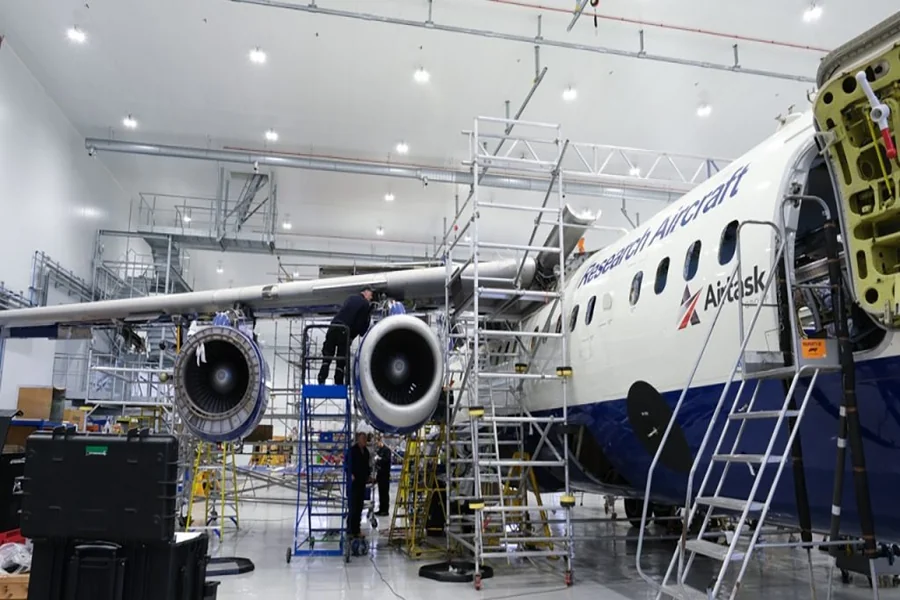
You may view aircraft maintenance as merely an isolated activity done on airplanes, but its real core is its inherent complexity and effectiveness in ensuring the total airworthiness of the aircraft. The various ongoing maintenance operations take place on an almost unforeseen basis and can extend from minor daily checks to huge overhauls planned many hours ahead. These must be carried out by various specialist teams such as commercial airplane mechanics and technicians of line maintenance, all of whose roles are intertwined.
1. Hangar Setup and Equipment
Hangars are designed specifically to have the tools and equipment to support various aircraft maintenance activities. Heavy-duty machines such as lift jacks and drum winches, along with basic but necessary equipment like power tools and measuring instruments, are commonly found. Large storage areas in hangars are designed specially to provide sufficient workspace for inspection and repair of the aircraft. Technicians make use of safety gear like pressurized restraint devices and helmets with visors to protect themselves from hot surfaces while working on the aircraft. The precise cleaning and careful organization of tools and parts allow the easy and safe movement of aircraft around the hangar during the work process.
2. Routine Inspection Steps
Every day check starts with a pre-flight inspection that ensures that all items are in befitting conditions prior to a flight. In addition to this, under these checks, the fuselage and wing surfaces are also keenly scrutinized for any wear or corrosion, as well as any other type of problems. Engines are also inspected and listened to by the technicians in order to detect any anomalies at an early stage. Then, technicians check the anomaly of fluid levels, and the absence of leaks is considered to be essential to safety. After the inspection, any notable findings are duly recorded in the maintenance logs as a proper record of the job done in order to meet regulatory and safety standards.
3. Specialized Repair Processes
In specialized repairs, the process starts with removing various aircraft components and ensuring easy access to the parts that need service. Non-destructive testing techniques are carefully chosen, as they reveal underlying problems without compromising component integrity. The technicians then replace worn-out and damaged parts with certified ones, again ensuring the safety of different systems. During repairs, instruments must be recalibrated and adjusted to be ready to do their functions accurately. Finally, all the work requires detailed testing to confirm that the system or the component is operating as per the known safety and operational standards.
4. Supply Chain and Parts Management
Efficient aircraft maintenance is hardly possible without a good supply chain and parts management. Orders of parts must be tracked correctly, and their schedules should be adhered to, for hangars to function with minimum delays. Stored parts include parts like the FAA-certified parts provided by Bogert Aviation, which are carefully monitored, and come with the assurance of quality. The availability of spare parts in stocks guarantees its availability and the methods of intelligent inventory management ensure prompt replenishments. All warranty claims, returns of defective parts are thoroughly expedited in such a manner that there is no hindrance to the work.
5. Regulatory Compliance and Documentation
The federal aviation regulations (FAR) basically simply provide the framework for the maintenance of aircraft, and compliance with airworthiness directives is a must. Almost at the end of every maintenance period, newer logbooks and notes on servicing ensure that the past maintenance of the aircraft is correct and updated. Internal and external audit checks are essential to ensure that all companies are doing the right thing in a timely manner and are not missing anything. Technical teams are also responsible for reporting maintenance results to the FAA and other relevant authorities. When all documents are maintained and digital recording systems are completed, the components become electronically traceable to the involved work and modifications.
Conclusion
A wide-ranging aircraft maintenance plan involves multiple important steps, from preliminary daily checks to complex repair work, all of which require incredible precision and synchronization of numerous functions. Do not just fly, comprehend what keeps you in the air, and make it a point to visit an aircraft maintenance facility and check out the work that goes into keeping the aircraft operation.