
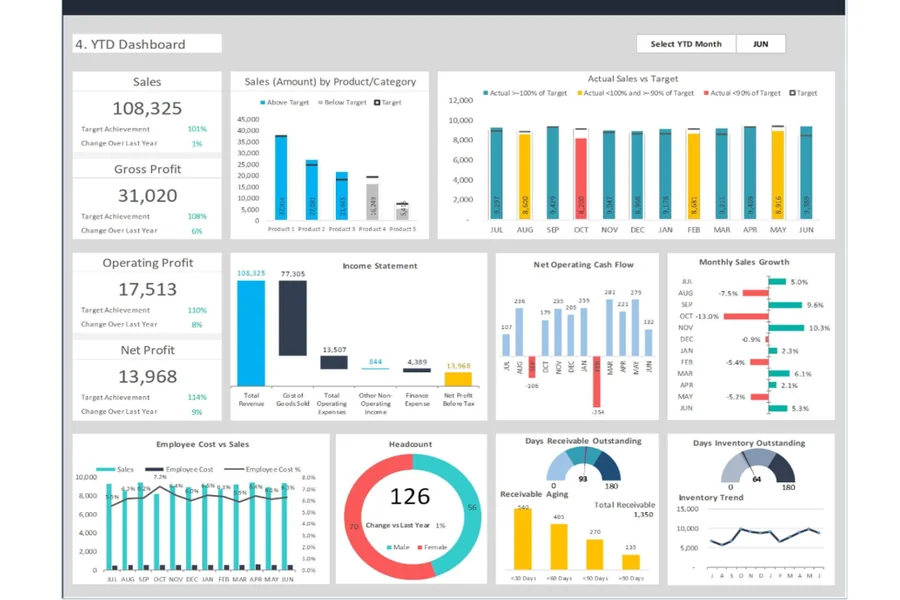
Introduction to CEO Dashboard
Executive leaders face a demanding work environment because their choices produce major effects, and they require immediate access to useful information. CEOs need to do more than review reports and attend meetings when they run their businesses. The process requires organizations to create a single accurate understanding of their present financial standing and operational and strategic position. A CEO dashboard serves as an essential management instrument which enables business success. The CEO dashboard provides real-time business performance data through a unified dashboard which eliminates the need to examine multiple departmental reports.
Organizations that expand their operations and develop greater complexity require better visibility between their different departments. Executives require tools that deliver both broad organizational insights and specific analysis of aspects. A CEO dashboard with proper design functions as a data display system which presents information through narrative form. The system shows business performance status while identifying upcoming problems to prevent them from becoming major issues and provides leaders with vital information to make confident decisions.
What Is a CEO Dashboard?
A CEO dashboard functions as a high-level business intelligence interface which serves senior executives as its primary user group. A CEO dashboard integrates vital performance indicators from finance and sales and operations and HR and other fundamental business areas rather than using separate departmental dashboards for detailed metrics. The report provides a complete business performance review which fulfills all strategic requirements of the CEO role.
The dashboard functions as an executive control center which enables leaders to track organizational performance metrics in real time. CEOs gain the ability to make quicker and more accurate decisions because key performance indicators update instantly or within a short period of time. The CEO dashboard functions as the main performance management system which eliminates the need to wait for monthly reports or request updates from department heads.
Organizations need dashboards to achieve their strategic oversight goals for success.
Organizations need to eliminate their reliance on traditional retrospective report waiting periods because the modern business environment requires companies to be agile to stay competitive. Leadership becomes more proactive through dashboards which allow organizations to detect emerging patterns and upcoming problems and new market possibilities. The strategic tool of a CEO dashboard enables organizations to achieve their business goals while helping leaders stay focused on vital strategic targets instead of getting bogged down by operational details.
Key Characteristics of an Effective CEO Dashboard
A CEO dashboard gains its value from the way it presents data alongside the specific information it shows. The design elements and user interface structure of the dashboard hold equal value to the actual metrics being displayed.
High-Level Summary with Drill-Down Capabilities
A CEO dashboard achieves its best performance through simple interfaces which display core metrics yet enable users to access supplementary information when needed. The dual-layer system enables executives to identify problems at first glance before they can investigate the underlying causes without needing access to additional reports or systems.
A CEO needs to see all key performance indicators at once through the dashboard to understand revenue achievement status and customer retention and operational cost management. The system provides substantial value through its ability to let users check individual numbers that seem unusual and view the specific factors which cause these numbers to be different from others such as department or product line performance.
Visual and Action-Oriented Design
Executives don’t have time to decode spreadsheets or interpret raw data. The dashboard needs to show data through visual elements which include charts and graphs and color-coded indicators. Users can identify patterns and detect abnormal data points and major changes through the visual elements.
A dashboard exists for reasons that extend past data display since it needs to drive users toward actions. The dashboard needs to show these events through visual signals which help users make required choices or start new conversations. The dashboard requires all its components to maintain clarity and focus because each element needs to support strategic thinking while performing its designated function.
Financial KPIs
A CEO needs to establish financial health as the fundamental goal of their organization. The evaluation of revenue performance represents the most essential financial metric which needs assessment based on its circumstances. The gross profit margin shows how well a company controls its expenses, but EBITDA offers a more detailed earnings view since it excludes non-core business expenses and unusual costs. Startups and high-growth businesses need to track their burn rates because these rates determine the duration of their existing resource availability. The financial KPIs enable CEOs to make strategic decisions about investments and cost-cutting and pricing and growth initiatives.
Sales and Marketing KPIs
Revenue is the result of sales and marketing efforts. The CEO dashboard requires sales pipeline health indicators which show active lead numbers and their position in the process and their conversion success rates. Organizations use customer acquisition costs to evaluate marketing performance, yet marketing return on investment metrics demonstrate that promotional activities create real value instead of wasting resources. These indicators help organizations make decisions about their growth strategy and market expansion and resource distribution.
Operational KPIs
A great strategy fails without strong execution. Operational KPIs function as performance indicators that help businesses achieve effective delivery of their products and services. Organizations track schedules to determine their delivery performance and their success in meeting project deadlines. The calculation of inventory turnover applies mainly to product-based businesses to show their stock management efficiency. Organizations evaluate their resource effectiveness through broader efficiency ratios which measure maximum resource achievement. The CEO can use these metrics to evaluate operational discipline for implementing changes that enhance production speed and minimize waste.
HR and People KPIs
Every organization needs its human workforce to achieve success. CEOs must monitor their workforce size and both employee turnover rates and employee satisfaction metrics. The indicators present both present-day organizational health status and future operational performance potential. The first sign of employee dissatisfaction often appears as higher employee turnover rates and decreased employee engagement before it affects productivity and innovation levels. The tracking of these KPIs enables organizations to develop effective plans for recruitment and training and cultural development.
Excel Dashboards for Simplicity
The solution of choice for smaller organizations and new businesses remains Excel because it provides both effectiveness and affordability. The combination of well-designed pivot tables and basic charts in Excel allows users to build an easy-to-use CEO dashboard which monitors important performance indicators. The system requires manual intervention for updates, but Excel provides users with flexibility to work with the software.
Conclusion
CEOs now use dashboards as essential operational tools which have evolved from optional features into vital systems for fast and clear leadership. In a competitive and ever-changing business landscape, having immediate access to key performance data is no longer optional, it’s essential. Bizinfograph offers ready-to-use dashboard templates on Finance, Sales, HR and Manufacturing.
