
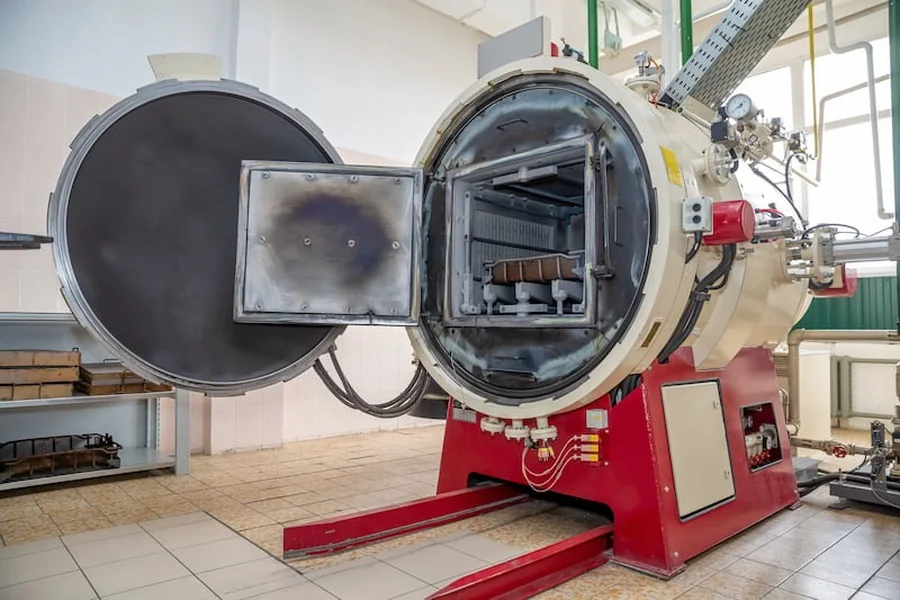
It is not by chance that metal becomes strong, but it is heated. The process that gives metal its tensile strength and plasticity is annealing, in the backdrop of all highly powered airplane wings, heavy-duty equipment, or smooth metal pieces. This is a modification that takes place in annealing ovens that are monitored with respect to temperature in such a manner that the actual structure of metals is pushed aside.
As the global heat-treating industry is projected to be US$152.51 billion by 2033, industries are insisting on more intelligent and low-energy-consuming furnace technologies. Thus, in the following blog, you will understand that not only in the production is the interpretation of the annealing furnaces to enhance the life of the metal but also the balance in the production between the life, toughness, and performance.
For those interested in seeing these processes firsthand, our facilities offer a unique opportunity to witness the intricate dance of heat and metal. The precision and care involved in annealing are truly remarkable, and observing it can deepen your appreciation for the craftsmanship behind durable metal products. If you’re curious to learn more about how these techniques are applied in real-world settings, consider taking a tour. Visit our Concord location to explore our state-of-the-art equipment and meet the experts who bring these processes to life. This experience not only enhances understanding but also highlights the importance of innovation in metalworking.
What Role Do Annealing Furnaces Play in Metal Transformation?
The inner structure determines the metallic strength, ductility, and machinability. That structure can be managed by the industries through annealing furnaces, which are employed to heat the metals to a certain temperature and then let them cool gradually. This is a gradual process that decreases strain within the company and improves malleability as well, and evades brittle quality that occurs in the production or welding procedure.
All the alloys react to heat differently, with stainless steel and copper being examples of such wires. The rationale behind the creation of the annealing furnaces is that they are likely to have high levels of temperature control, which is 600°C to 1200°C. Such furnaces will offer an oxygen-controlled or any other inert environment that avoids oxidation and ensures proper cleaning results are achieved. The end product is harder parts that are usable indefinitely.
Why Are Annealing Furnaces Essential Across Industries?
- Automotive manufacturing: It increases the elasticity of the body panel and engine material steel, which reduces the cracking in shaping.
- Aerospace manufacturing: It ensures that turbine blades and structural alloys do not delaminate due to the high temperatures and pressure without deformation.
- Electrical industry: Copper and aluminum wires are added to increase their conductivity and durability.
- Glass and ceramics: Thermal stress relief in glass sheets and molds and fracture prevention during cooling.
- Tool and die making: Enhances cutting tool hardness and precision and die forming hardness and precision.
- Construction industry: Bridges, buildings, and infrastructural construction with reinforcement with steel bars and steel plates.
What Happens When Annealing Is Ignored?
- Metal fatigue: Unrelieved, specifically, internal stress causes cracks and the timely failure.
- Poor efficiency in conductivity: Specifically, untreated metal is not as conductive for electrical applications.
- Reduced component life: Brittle or stressed parts that are high-wear parts will wear out faster, adding to the costs of maintenance.
- Low-quality production: The batches of the products may not be consistently good without the annealing furnace, and this will imply rejection and wastage.
How Are Modern Annealing Furnaces Evolving?
The annealing furnace is the new generation with the elements of automation, digital control, and intelligent sensors to control with accuracy. Digital thermoregulators maintain all the degrees fixed and exclude the load on materials, and save energy. The manufacturers are also moving towards electric and hybrid cars in order to minimize carbon emissions and achieve consistent heating.
Continuous-belt furnaces, which are characterized by the use of vacuum, are gaining popularity in large-volume and contamination-sensitive work. These systems are able to offer better quality and faster cycle time by decreasing the amount of oxygen available. Smart furnaces, which will expose process control and predictive maintenance, will provide the future of annealing in a global production line with reduced downtimes and maximum throughput.
What Lies Ahead for Heat Treatment and Industrial Durability?
The furnaces used during the annealing processes will be more significant to the sustainable production since the different industries of the world are switching to smarter and cleaner manufacturing. Digital remote monitoring, through the aid of IoT, is simplifying the processes of calibration of heating cycles, which makes the process more efficient and transparent.
Moreover, industrial heat treatment requirements are being changed in conjunction with the regulatory requirements, which promote favorable regulations for the low-emission furnace and energy-conservative processes. Companies investing in the newest annealing furnaces have been future-proofing production with tradeoffs between the strength of metal and the environment.
The art of annealing is, necessarily, the art of heat management, but above all, it is the science of the life cycle and can be applied to extract the maximum performance out of the material as well as the generation of high-precision production.
Precision Partners for the Future of Heat Treatment
The military strength lies actually in precision and consistency. As efficiency and service life are sought in greater amounts and extended longevity of service in industries, the art of annealing furnaces will be the measure of competitiveness and quality in most locations around the world. Even heat distribution and reproducibility of heat is no longer privileges but the order of the day.
Implicitly, to the interested parties who are interested in being assured of traceable and reliable furnace performance, the collaborator, such as those at Tempsen, can offer a meaningful solution through their designed furnace annealing furnaces together with their expertise in temperature calibration. Their solutions aim to control, ensure safety, and customization, and help industries to maintain the results without compromising the sustainability and energy goals. The mute displays of quality in the metal durability world consist of consistency and uniformity.