
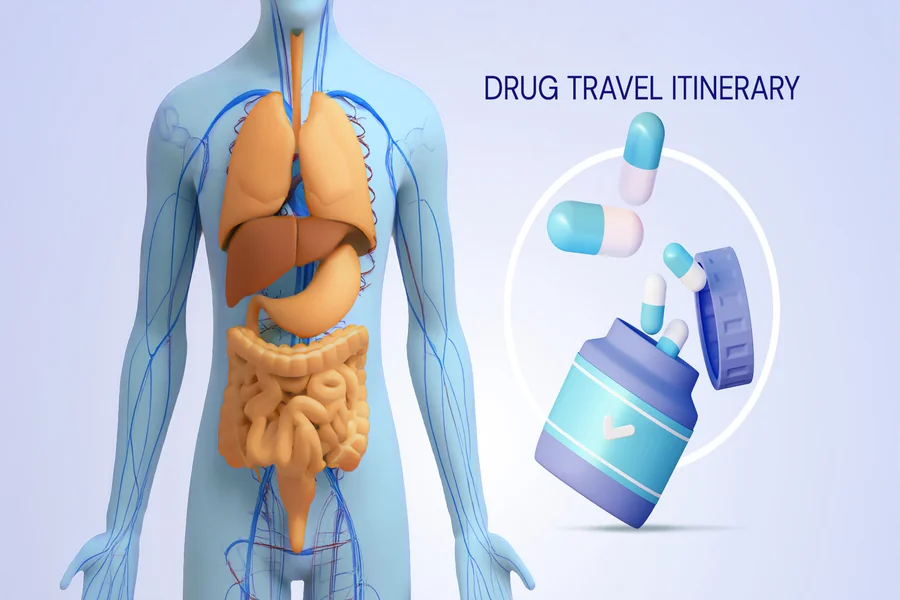
Have you ever wondered how a pill taken by mouth ends up treating pain in your back or infection in your lungs? The answer lies in pharmacokinetics — the science that explains what the body does to a drug after it’s administered. From the moment you swallow a medication to the time it’s eliminated, a complex journey unfolds involving four key processes: absorption, distribution, metabolism, and excretion (ADME).
Whether you’re a healthcare professional, a pharmacy student, or simply curious about how medications work, understanding these core concepts is crucial. Let’s break down the basics of pharmacokinetics and see how they influence everything from dosing to drug effectiveness.
1. Absorption: How Drugs Enter the Bloodstream
Absorption is the process by which a drug moves from its site of administration (like the stomach or muscle) into the bloodstream. The route of administration — oral, intravenous (IV), subcutaneous, etc. — plays a major role in how fast and how much of the drug gets absorbed.
- Oral medications must pass through the digestive tract and may be affected by stomach acidity, food intake, and digestive enzymes.
- IV drugs skip the absorption phase entirely, entering the bloodstream directly and providing 100% bioavailability.
Why it matters: Poor absorption can lead to reduced drug effectiveness. Pharmacokinetics services often study how formulation changes or food interactions affect absorption to optimize treatment.
2. Distribution: Where the Drug Travels in the Body
Once in the bloodstream, the drug travels throughout the body to reach its target tissues or organs. This phase is called distribution.
Factors influencing distribution include:
- Blood flow to various tissues
- Plasma protein binding (drugs may bind to proteins like albumin, making them temporarily inactive)
- Cell membrane permeability (can the drug pass through tissue barriers like the blood-brain barrier?)
Why it matters: A drug’s ability to reach the right tissues in sufficient concentrations determines whether it can perform its intended function. If distribution is poor, even a well-absorbed drug may be ineffective.
3. Metabolism: How the Body Breaks Down the Drug
Metabolism is the body’s way of chemically modifying a drug, often in the liver, to prepare it for excretion. This usually transforms the drug into more water-soluble forms.
The liver uses enzymes — particularly the cytochrome P450 family — to metabolize many drugs. Some drugs become inactive, while others become active metabolites, which might be more potent or longer-lasting than the original compound.
Why it matters: Variations in liver enzyme activity (due to genetics, age, liver disease, or other drugs) can dramatically affect how a drug works. Pharmacokinetics services help predict these variations to improve safety and avoid adverse effects.
4. Excretion: How the Drug Leaves the Body
The final step is excretion — how the body gets rid of the drug. The kidneys are the primary organ for excretion, removing drugs through urine. Some drugs are also excreted via bile, sweat, breath, or feces.
Why it matters: If a drug isn’t excreted efficiently, it can accumulate in the body, leading to toxicity. In patients with kidney or liver impairment, pharmacokinetics services may adjust dosing schedules to ensure safe clearance.
The ADME Framework: Why It’s Crucial in Medicine
Together, Absorption, Distribution, Metabolism, and Excretion (ADME) shape a drug’s pharmacokinetic profile — essentially, its journey through the body. This profile determines:
- How fast the drug works
- How long it lasts
- How often it needs to be taken
- How much is required for it to be effective without being harmful
Pharmacokinetics services play a key role in drug development and clinical practice by modeling ADME processes. This helps:
- Identify proper dosage regimens
- Tailor treatments for special populations (children, elderly, people with liver/kidney disease)
- Minimize side effects and drug interactions
Real-World Example: Why One Size Doesn’t Fit All
Imagine two patients take the same dose of a blood pressure medication. One responds well, while the other experiences side effects. The difference might be due to:
- Slower metabolism in one patient
- Higher protein binding that limits active drug levels
- Impaired kidney function affecting excretion
Understanding pharmacokinetics allows doctors to personalize treatments and improve outcomes.
Conclusion: Mastering the Science Behind the Pill
Pharmacokinetics may sound technical, but its principles impact every medication you’ve ever taken. From how fast a painkiller works to why some antibiotics need to be taken multiple times a day, the ADME processes shape it all.
Whether you’re developing new drugs or just trying to understand your prescription, pharmacokinetics services provide essential insights into how drugs behave in the body — making modern medicine safer, smarter, and more effective.
