
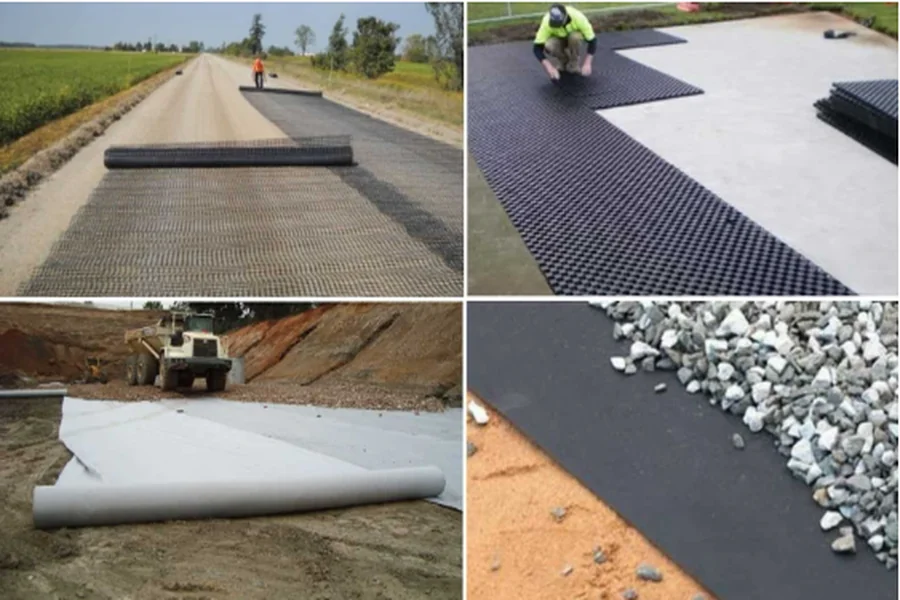
Geotextiles are synthetic textile materials widely used in civil, geotechnical, and environmental engineering. Since their introduction in the 1950s, these materials have played a critical role in soil separation, filtration, drainage, reinforcement, and protection. Manufactured primarily from polymers such as polypropylene (PP) or polyester (PET), geotextiles allow controlled water flow and mechanical interaction between soil and structural systems — a vital aspect of modern infrastructure performance.
At GeoSynSource, we specialize in geosynthetic solutions designed for long-term soil stability, erosion control, and environmental protection. Our engineering team collaborates closely with designers and contractors to ensure that the right geotextile type is selected for each project, meeting both performance and regulatory requirements.
According to ISO 10318-1: Geosynthetics — Terms and Definitions, geotextiles are generally categorized into woven, knitted, and nonwoven types. Each type has distinct mechanical and hydraulic characteristics, making it suitable for specific field applications.
1. Woven Geotextiles (Open-Mesh Fabrics)
Manufacturing and Structure:
Woven geotextiles are produced by interlacing two sets of yarns — warp and weft — to form a stable, grid-like structure. They are typically made from high-tenacity polypropylene or polyester filaments, ensuring durability and strength under load.
Key Properties:
- High tensile strength and low elongation (ASTM D4595: up to 100 kN/m)
- Controlled pore structure with defined Apparent Opening Size (AOS) (ASTM D4751: 0.1–0.6 mm)
- Low permittivity (ASTM D4491: typically < 0.5 s⁻¹)
Engineering Significance:
Woven geotextiles are ideal for reinforcement and separation in roadway and embankment construction. The Percent Open Area (POA) indicates the proportion of open space between filaments — a key parameter that affects clogging resistance. While their low permeability can limit drainage capacity, it enhances filtration precision and soil retention performance.
Applications:
- Subgrade stabilization in highways
- Reinforcement layers in retaining walls or embankments
- Erosion control under riprap and gabion systems
2. Knitted Geotextiles
Manufacturing and Structure:
Knitted geotextiles are made by interlooping yarns, producing flexible two-dimensional or three-dimensional fabrics. Warp-knitted geotextiles offer biaxial strength, while 3D knitted geonets enhance drainage through in-plane and out-of-plane channels.
Key Properties:
- Moderate tensile strength with excellent flexibility
- Multiaxial reinforcement potential, useful in foundation improvement
- High adaptability to irregular subgrades
Applications:
- Foundation improvement and slope reinforcement
- Drainage layers in pavements or coastal protection systems
- Temporary access roads where flexibility is prioritized over stiffness
Although knitted geotextiles represent a smaller market share, their demand is rising in specialized infrastructure and geocomposite applications, particularly where structural flexibility and complex stress distribution are required.
3. Nonwoven Geotextiles (Closed Fabric)
Manufacturing and Structure:
Nonwoven geotextiles are produced by bonding polymer fibers through needle-punching or heat-bonding methods. Most are made from polypropylene (PP) due to its excellent chemical stability and resistance to biological degradation.
Key Properties:
- High permittivity and water flow capacity (ASTM D4491: typically 0.5–2.0 s⁻¹)
- Excellent resistance to chemical and biological attack
- Available in multiple mass per unit area (100–800 g/m²)
- Can be UV-stabilized for exposed applications
Engineering Significance:
Nonwoven PP geotextiles are widely used for filtration, separation, and protection in civil, environmental, and mining projects. They maintain dimensional stability under load and retain permeability over time, even under conditions of differential settlement.
Applications:
- Filtration and drainage beneath roads, railways, and retaining structures
- Liner protection in landfills, heap leach pads, and tailings dams
- Erosion control in riverbanks and coastal zones
- Cushion layer beneath geomembranes or drainage composites
4. Engineering Case Example: Nonwoven PP Geotextile in Heap Leach Pad Design

A properly designed heap leach pad requires a durable containment system that both protects groundwater and maximizes ore recovery. In such systems, nonwoven polypropylene geotextiles are installed above geomembranes to provide puncture protection, drainage, and filtration.
At GeoSynSource, our technical specialists frequently assist heap leach and mining operators in selecting nonwoven PP geotextiles with the right mass per unit area and filtration capacity. When paired with compatible drainage liners, these geotextiles improve liner protection, solution flow, and long-term containment integrity — essential factors in demanding mining environments.
5. Standards and Quality Control
To ensure consistent performance and safety, geotextile testing and quality control follow several key international standards:
- ASTM D4354 – Sampling of Geosynthetics
- AASHTO M288 – Standard Specifications for Geotextiles
- ISO 10319 – Wide-width Tensile Test for Geotextiles
These standards establish reliable quality assurance procedures, ensuring that materials meet project-specific performance requirements under field conditions.
Conclusion
Understanding the differences between woven, knitted, and nonwoven geotextiles is essential for engineers tasked with designing safe, efficient, and sustainable soil-structure systems.
- Woven geotextiles offer superior strength and reinforcement.
- Knitted geotextiles provide flexibility and multi-axial load distribution.
- Nonwoven polypropylene geotextiles excel in filtration, separation, and protection.
As a trusted partner in the geosynthetics industry, GeoSynSource geotextile solutions comply with ASTM, ISO, and project-specific standards, helping engineers build infrastructure that is safer, longer-lasting, and more environmentally responsible.
